Approach to the Unwell Child
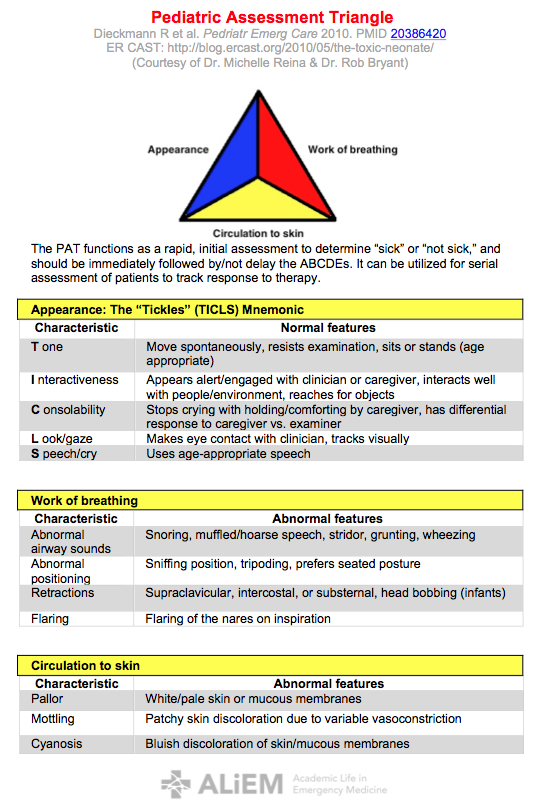
The Paediatric Assessment Triangle
The Paediatric Assessment Triangle (PAT) registers instantly on first impression of the child, alerting the clinician to any imminent action required. It’s the quantification of what clinicians instinctively perform qualitatively upon first encounter with any child. Staying mindful of this — usually largely unconscious — analysis positions it into a more tangible part of your thought process. Examining what it is that made the initial impression, and rendering that impression more explicit, makes it easier to act on it, and to act in a specific, systematic way.
This kind of mindfulness holds you in good stead in any situation of urgency, because you’re always poised to move and respond, promptly and appropriately, with both skill and due care.
- Appearance: Tone, Interactiveness, Consolability, Look/gaze, Speech or cry (the “TICLS” mnemonic) — in shorthand: Alert, Anxious, Cry
- Work of Breathing: Tachypnoea, chest retractions, nasal flaring, abnormal airway sounds (grunting, stridor, wheeze)
- Circulation: Pallor, mottling, cyanosis

Having made this reflex assessment, take the time to work through the numbers.
Respiratory rate
Note the child’s positioning, and count their respiratory rate.
| Age | Respiratory rate (breaths/min) |
|---|---|
| Newborn | 30–60 |
| First 6 months | ~30–50 |
| Second 6 months | ~25–45 |
| 1–4 years | 20–30 |
| 4–6 years | 20–25 |
| 6–12 years | 16–20 |
| Adolescent | ~20 |
As a rough anchor across the broader bands: ~40 for infants,
~30 for preschool, ~20 for adolescents.
Quickly listen for equal air entry and any added sounds.
Pulse rate and blood pressure
| Age band | Pulse rate (beats/min) | Systolic BP (mmHg) |
|---|---|---|
| Infant | ~160 | ~80 |
| Preschool | ~120 | ~90 |
| Adolescent | ~100 | ~100–110 |
Take the opportunity to check capillary refill time and skin turgor
now.
Temperature
| Site | Typical relationship to oral |
|---|---|
| Oral | 36.5–37.5°C (varies with recent oral intake) |
| Rectal | ~0.3–0.6°C higher than oral |
| Tympanic | ~0.3–0.6°C higher than oral |
| Axillary | ~0.3–0.6°C lower than oral |
Look and feel the peripheries for pallor, mottling, cyanosis, and
coolness.
Putting it together
Now indulge in one — only one — slow, deep breath before taking any immediate steps necessary: oxygen mask, IV line and fluids. This is where your Broselow Tape comes in handy.
You’ve done your primary survey. Well done.
You can breathe more easily now. But don’t tarry long — promptly move to a secondary, head-to-toe survey. Don’t forget to look for eye, dental, and ENT emergencies.
Further reading
- Pediatric Emergency Playbook (ACEP Now)
- ALiEM— Pediatric Assessment Triangle
- Rapid Pediatric Assessment (ddxof.com)
Downloads
- Assessment of the unwell child — Corrales, AFP 2010
- Vital Signs Reference Chart — PedsCases: Pediatrics for Medical
Students