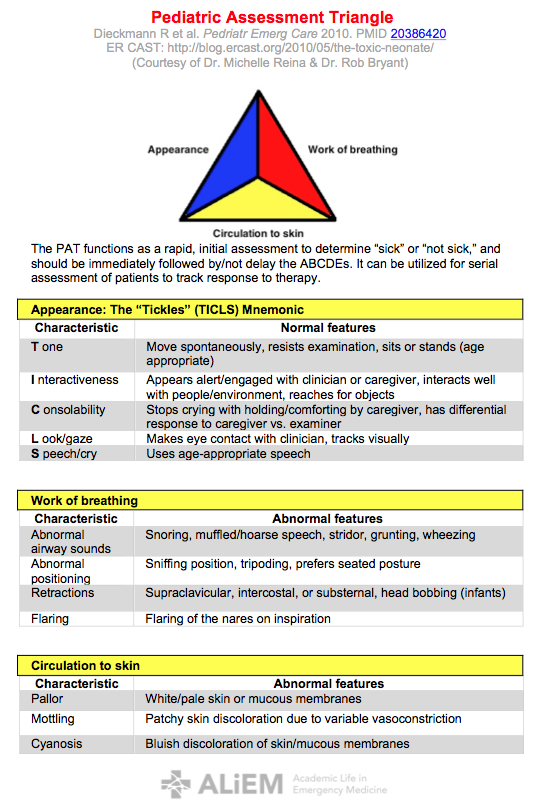
The Paediatric Assessment Triangle (PAT) paradigm registers instantly upon first impression of the child, alerting the clinician toward any imminent action required. It is the quantification of what clinicians instinctively perform qualitatively upon first encounter with any child. Remaining mindful of this previously largely unconscious analysis, however, positions it into a more tangible repository within thought processes—examining what it is that has made the initial impression—and the more tangible and explicit the rendering of these thought processes, the easier it is to act on them and act on them in a specific and systematic way.
It is this sort of mindfulness that holds you in good stead in any situation of urgency. Because you are always poised to move and respond, promptly and appropriately, with both skill and due care.
- Appearance: Alert, Anxious, Cry
- Work of Breathing: Tachypnoea, Chest Retractions, Nasal flaring
- Circulation: Colour, Warmth

Having made this reflex assessment, take the time to:
Note positioning of the child and count their respiratory rate:
- ∼ 40 infant
- ∼ 30 preschool
- ∼ 20 adolescent
30-60 newborn → 40 ± 10 first six months → 25-45 second six months → then come down by 5s for the following ages:
- 1-4 years: 20-30
- 4-6 years: 20-25
- 6-12 years: 16-20
Quickly listen now for equal air entry and any added sounds.
Check the PR:
- 160 Infant
- 120 Preschool
- 100 Adolescent
and SBP:
- 80 Infant
- +10 Preschool
- +20 adolescent
Take the opportunity to check CRT and skin turgor now.
Take the temperature
- Per Oral: 36.5 – 37.5 (depending on recent intake)
- about half a degree lower per tympanic or per axilla
Look and feel the peripheries for pallor, mottling, cyanosis, and coolness.
Now indulge in one (only one) slow deep breath before taking any immediate steps necessary — e.g. oxygen mask, IV line + fluids. This is were your Broselow Tape comes in handy.
That’s it. You’ve done your Primary Survey. Well done.
You can now breathe more easily. But don’t tarry long.
Promptly move to a Secondary, head-to-toe, survey.
Don’t forget to look for eye, dental, and ENT emergencies.
Further Reading
Download
Assessment of the unwell child – Corrales, AFP 2010
Vital Signs Reference Chart 1.2_1 – PedsCases: Pediatrics for Medical Students. Available at http://www.pedscases.com/pediatric-vital-signs-reference-chart.
![Paediatric Assessment Triangle (PAT) [Emergency Medicine Cases]](https://i0.wp.com/lonegp.com/wp-content/uploads/2018/02/appearance.jpg?w=302&h=208&ssl=1 "appearance")
![Emergency Trolley with colour-coded equipment draws based on the Broselow Tape [Wikimedia Commons]](https://i0.wp.com/lonegp.com/wp-content/uploads/2018/02/btape2.jpg?w=131&h=208&ssl=1 "BTape2")
![Colour for weight correlation of the Broselow Tape [Wikimedia Commons]](https://i0.wp.com/lonegp.com/wp-content/uploads/2018/02/screen-shot-2018-02-27-at-6-38-04-pm.png?w=211&h=208&ssl=1 "Screen Shot 2018-02-27 at 6.38.04 pm")