Management of Acute Severe Asthma (esp. of a child)
Note the child’s:
- Colour
- Position
- Level of Consciousness
Look specifically for/at:
- is the child fatigued?
- are they working hard to breathe? (in which case they will become fatigued if not already)
- count the respiratory rate
- number of words able to speak without stopping: i.e. words, phrases, or sentences
- air entry ± wheeze
- heart rate
- blood pressure ± pulsus paradoxus
Immediate interventions:
- Oxygen: aim for oxygen saturation > 94%
- 3 x q 20min salbutamol + ipratropium
- 1 mg/kg oral prednisone
- IV access
Take a directed history:
- Determine the events leading to the episode
- recent and current treatment(s)
- previous history, including severity (ICU / intubation)
- allergies, h/o anaphylaxis, FHx atopy or asthma
Continuous nebulised salbutamol with 8L/min O2
- hydrocortisone 4 mg/kg
- 2/3 maintenance fluids: 0.9% Normal Saline 1L + 20 mmol KCl
- 50% magnesium sulphate: 2 mmol/mL
- 0.2 mmol (0.1 mL) / kg solution over 20 min diluted with 0.9% saline at least 1:1 (max 8 mmol)
- ± 0.12 mmol (0.06 mL) / kg per hour infusion
- aminophylline
- 5 mg / kg loading dose over 30 min, then
- 0.9 mg / kg per hour infusion (< 9 years old) or 0.7 mg / kg per hours infusion (> 9 years old)
- salbutamol IV (adrenaline)
- start infusion at lower end of 1-5 mcg / kg per min and titrate
- draw up 50 mL of 5 mg / 5 mL salbutamol intravenous solution
- weight (kg) x 0.06 mL per hour (1 mcg / kg per min) – max 40 kg
- start infusion at lower end of 1-5 mcg / kg per min and titrate
- NIV: CPAP
- intubation
Watch for:
- tachycardia
- arrhythmia: tachyarrhythmia, including SVT (esp. HR > 200)
- hypotension
- vomiting
- metabolic acidosis
- hypokalaemia: check serum K+ q 6-8H
Note: The benefit of intravenous magnesium sulphate in acute (severe) asthma in children has been demonstrated in two meta-analyses.
§
Acute Management of Non-severe Asthma
Dyspnoea seen only with activity (i.e. PEF > 70%) is usually managed at home, as prompt relief is obtained with inhaled bronchodilators (± ICS).
- dyspnoea limits activity: PEF 40-70% – usually seen in office / ED
- frequent SABAs + oral steroids
- dyspnoeic at rest: PEF < 40% – usually admitted
- frequent SABAs + Ipratropium q 20 min (or cont. for 1 hour)
- oral steroids
- ± supplemental oxygen (Sats > 90%)
- unable to speak:
- minimal / no relief from frequent inhaled SABAs
- intravenous corticosteroids
- supplemental Oxygen
- ± magnesium sulfate
- ± parenteral beta-agonists
- ± CPAP
- ± intubation
Longer-term Asthma Control
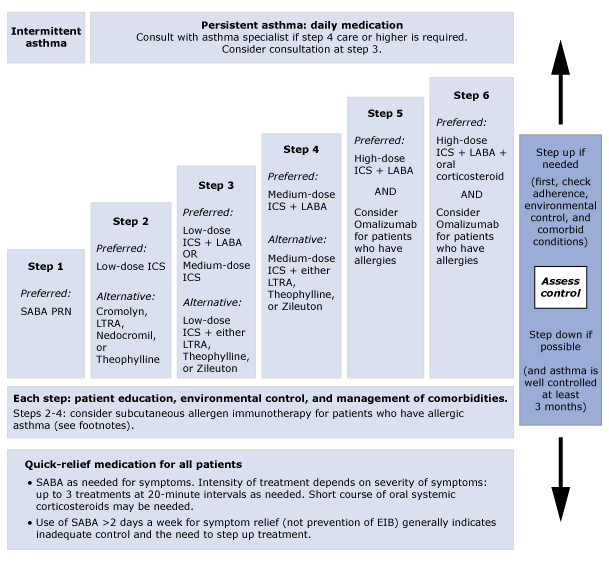
Base-line control of asthma is achieved in primary care, including treatment adjustments incorporating, if need be, new therapies, followed by treatment escalation to a respiratory physician, if required.
Regular assessment of symptoms is imperative. Afterward, don’t overlook non-pharmacological approaches to management. Then consider optimising adherence and technique. Finally, consider step-down when stable or, conversely, step-up and referral if difficulty stabilising.
Statistics
- 300 million people worldwide
- + 100 million within five years (2025)
- prevalence high in Australia (and NZ), where 1 in 9 have asthma
- GPs routinely overestimate control achieved in patients
- suspect sub-optimal control for 6% of their patients
- compared to 32% of patients who feel they are uncontrolled
Practical Strategies: “Asthma Control”
- Achieve control defined by symptoms, activity, reliever use, lung function.
- Reduce future risk predicted by instability/worsening, exacerbations, loss of lung function, adverse medication effects.
- Well controlled with no preventer (40%): follow-up at least yearly
- Well controlled with good preventer adherence (15%): consider down-titration
- Uncontrolled despite good preventer adherence (20%): confirm adherence and check inhaler technique; treat comorbidities
- Under-treated (25%): start preventer or improve adherence
Recurring themes:
- Other diagnoses / complicating comorbidities:
- COPD: if FEV1 bronchodilator response 400 mL or fully reversible, treat as asthma
- allergic rhinitis
- GORD
- cardiac disease
- Poor adherence to inhaled corticosteroid (ICS) or poor inhaler technique: always check technique before step-up; only 10% people use their inhaler correctly
- Triggers
- smoking: higher ICS doses may be needed
- allergens
- animal dander
- mould
- occupational exposures
Global Initiative for Asthma (GINA) Guidelines suggest a continuous cycle of assess, adjust, and review response.
Asthma Action Plan
- usual asthma and allergen medicines
- clear instructions on how to change medication
- when and how to get medical care, including emergency situations
Tiotropium
- long-acting muscarinic antagonist (“anti-bronchoconstrictor”)
- attach to M3-muscarinic receptors: most important for contraction of airway smooth muscle and for mucus secretion
- block acetylcholine signalling: maintain airway in open position
- safe and effective add-on to ICS / LABA regimen
- ↓ risk severe exacerbation
- improved asthma control
- improves lung function
- caution with
- narrow-angle glaucoma
- prostatic hyperplasia or bladder-outlet obstruction
In Australia, for PBS subsidy, need to be on medium-high dose LABA/ICS and an episode requiring oral corticosteroids in the last year.
Further, often specialist, testing:
- Pulmonary function tests
- Bronchial provocation
- blood / sputum eosinophil level
- IgE
- fractional exhaled nitric oxide (FeNO)
Remember that asthma is a heterogenous phenotype that might require specialist characterisation and for which biological therapies for allergic / atopic phenotypes with high levels TH2 immunity: mepolizumab; omalizumab.
- severe asthma with high IgE / eosinophil counts
- typically early onset
- atopic / allergic history
- It is for this group that corticosteroids are also most effective
Omalizumab is an anti-IgE monoclonal antibody given by fortnightly or monthly sci for > 12 years old with moderate-severe allergic asthma (raised IgE) not controlled on ICS.
Mepolizumab is an anti-IL5 monoclonal antibody given by monthly sci for > 12 year olds with severe, refractory eosinophilic asthma.
PBS restricts these biologicals to patients seeing a respiratory specialist for at least 12 months.
By contrast, non-atopic asthma (low TH2) is a neutrophilic inflammation typically adult-onset in obese smokers.
References:
- The Pediatric Emergency Medicine Resource. 5th Edn. AAP/ACEP. Burlington, MA: Jones & Bartlett, 2011.
- Lee, Philip. “Asthma.” Lecture. Sydney General Practice Day Aug 26, 2017.
- Asthma in Neonates and Children. NETS.
Further Reading:
- Mepolizumab for asthma, Australian Prescriber
- National Asthma Council

