There are many types of lipids or fats in the body. Lipids form an integral part of the cellular membrane. Cell membrane lipids include cholesterol, glycolipids and phospholipids. Fats are also an efficient, light-weight fuel store. Because it is energy dense and light in weight, fat is the “go-to” long-term storage fuel for a mobile species. Myelin, the spongy substance that envelops most neurons, is a fat essential for neurological function. Fats are critical to bile salt circulation and to body steroid production. Fats remain essential to body function.
Conditions of fat excess such as atherosclerotic heart disease from too much saturated fat in the diet can lead to great morbidity and are a leading cause of mortality. The predominant lipid of the human body are the neutral fats known as triglycerides. Triglycerides have three fatty-acid chains attached to a glycerol backbone. Fatty acids are hydrocarbons, chains formed of carbon and hydrogen.
Whether Saturated or Unsaturated confers relative flexibility to the carbon linkages in the fatty chain. This flexibility to a fatty acid chain is considered of importance in health and disease. Unsaturated fatty acid chains are more flexible and malleable while saturated fatty acid chains are more fixed and rigid in their carbon chain. This molecular property of fatty acids confers to them their physical property; why some fats are liquid at room temperature and others are not; and why saturated fats are more deleterious to health than the unsaturated fats.
Here is a more complete picture of a triglyceride molecule made (as they are) of three fatty-acid chains attached to a glycerol – i.e. a triacyl glycerol (TAG) molecule.


A fatty-acid chain can have either single or double (or rarely triple) carbon-carbon bonds. A fatty acid chain of only carbon-carbon (C-C) single bonds is said to be saturated. Saturated fats are typically solid at room temperature; as their Carbons are saturated with Hydrogen. These “solid fats” are found in animal products and are associated with atherosclerotic cardiovascular disease. The American Heart Association recommends people ingest no more than 13 g saturated fat a day.3
When one or more C-C bonds in the chain are double, the chain is said to be unsaturated; because, the individual carbons are not saturated with hydrogen. The saturated fat (TAG) above has all single C-C bonds in all three fatty acid side-chains. The schema of an unsaturated fat by contrast shows at least one double or triple bond in one of its hydrocarbon chains:

This fat or triglyceride is (again) made up of three fatty-acid chains linked to glycerol (Note that the word “fat” is a colloquial term that can refer either to a Fatty Acid or the TAG). The three fatty-acids, from top to bottom, are palmitic acid (saturated), oleic acid (unsaturated), and alpha linolenic acid (unsaturated). Palmitic acid has no double bonds and is solid at room temperature; oleic acid has one double bond, linolenic acid has three, making both liquid at room temperature.
Esters of fatty acid with alcohol, e.g. 1 glycerol + 3 fatty acids – i.e. esterifying 3 hydroxyl groups of glycerol with three fatty acid molecules to form glycerol esters. Plant-based triglycerides are mostly oils, animal-based triglycerides are mostly solid fats.

That phase-state of fats is an important determiner in health. All fatty acids have a polar head at their glycerol end courtesy of the oxygen molecules. They have a large non-polar (hydrophobic) tail.

Simple lipids:
- Fatty acids
- Triacylglycerols, diacylglycerols, and monoacylglycerols – the TAG structural diversity depends on the type of its fatty acid, the position of its ester bond on the glycerol backbone, and the degree of unsaturation.
- Waxes (esters of fatty acids with higher alcohols – Sterol esters (cholesterol–fatty acid esters); non-sterol esters (vitamin A esters, and so on)
Compound lipids – a lipid + a non-lipid:
- Phospholipids – Phosphatidic acids (i.e., lecithin, cephalins); Plasmalogens; Sphingolipids (e.g. sphingomyelins)
- Glycolipids – carbohydrate containing
- Lipoproteins – lipids in association with proteins


Derived lipids: derivatives such as sterols and straight-chain alcohols obtained by hydrolysis of those lipids in groups 1 and 2 still possess general properties of lipids) solubility in organic solvents such as ether, chloroform, and acetone

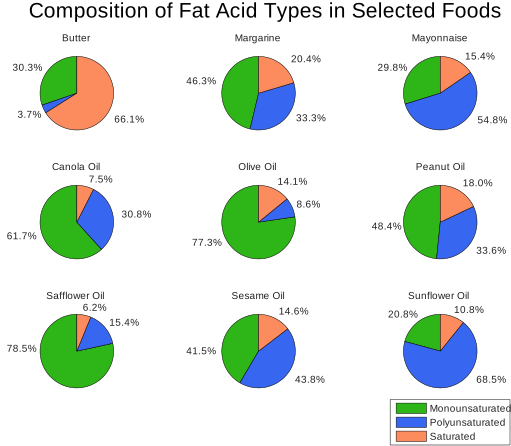
Dietary Preference should be given to monounsaturated over polyunsaturated and saturated fats.

DIGESTION OF FATS: Dietary fats are emulsified by admixing with bile salts.

ABSORPTION OF FATS: Cholesterol and phospholipids

TRANSPORT & STORAGE:
Lipoproteins – Lipids resynthesized in the enterocytes, together with fat-soluble vitamins, are collected in the cell’s endoplasmic reticulum as large fat particles. While still in the endoplasmic reticulum, the particles receive a layer of lipoprotein B-48 on their surface.
Apolipoproteins – one of nine types of protein component of lipoproteins, tend to stabilize the lipoproteins as they circulate in the aqueous environment of the blood
Chylomicrons – re-formed lipid derived from exogenous sources leaves the enterocytes (intestinal mucosal cells) largely in the form of chylomicrons
Very Low Density Lipoprotein (VLDL) and Low-Density Lipoproteins (LDL) – in the liver from endogenous triacylglycerol
LIVER & ADIPOSE TISSUE


There are four major classes of circulating lipoproteins, each with its own characteristic protein and lipid composition, distinguished by the relative amount of lipid and protein. Their structure reflects a conglomerate of individual members that have come together in manner to minimize hydrophobic contact with water.
| Human plasma lipoproteins: characteristics of the lipoprotein classes and shows the correlation between composition and density. | |||||
| chylomicron | VLDL | IDL | LDL | HDL | |
| Density (g/ml) | <0.95 | 0.950-1.006 | 1.006-1.019 | 1.019-1.063 | 1.063-1.210 |
| Components (% dry weight) | |||||
| protein | 2 | 7 | 15 | 20 | 40-55 |
| triglycerides | 83 | 50 | 31 | 10 | 8 |
| free cholesterol | 2 | 7 | 7 | 8 | 4 |
| cholesteryl esters | 3 | 12 | 23 | 42 | 12-20 |
| phospholipids | 7 | 20 | 22 | 22 | 22 |
| Apoprotein composition | A-I, A-II, B-48, C-I, C-II, C-III | B-100, C-I, C-II, C-III, E | B-100, C-I, C-II, C-III, E | B-100 | A-I, A-II, C-I, C-II, C-III, D, E |
| Source: From Christopher K. Mathews, K.E. van Holde, and Kevin G. Ahern, Biochemistry, 3rd ed. (2000), Table 18.1. | |||||
The hyrdophobic core of the lipoprotein molecules is of TAG and cholesteryl esters each with unsaturated fatty acid chains maintaining a liquid consistency to the core of the molecule at body temperature.

Because the lipid and protein composition is reflected in the density of each lipoprotein, density, an easily measured attribute, forms the operational basis of defining the lipoprotein classes.

Works cited:
Advanced Nutrition and Human Metabolism: Fifth Edition.
Morvaridzadeh M, Zoubdane N, Heshmati J, Alami M, Berrougui H, Khalil A. High-Density Lipoprotein Metabolism and Function in Cardiovascular Diseases: What about Aging and Diet Effects? Nutrients. 2024; 16(5):653. https://doi.org/10.3390/nu16050653.
https://www.heart.org/en/healthy-living/healthy-eating/eat-smart/fats/saturated-fats


Leave a Reply